
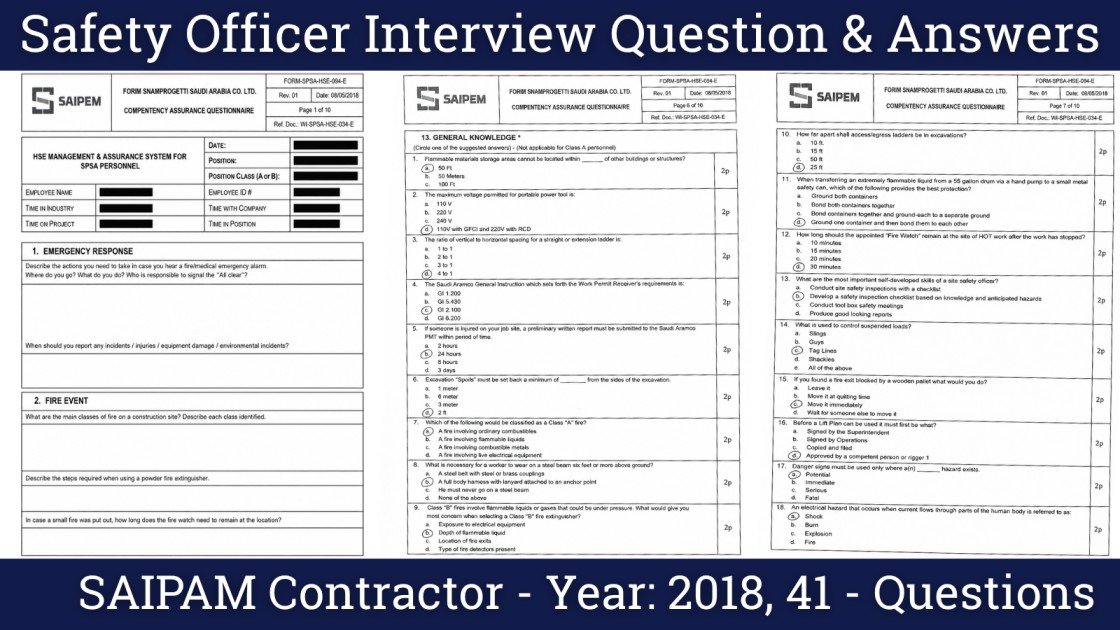
In this article, you will find interview questions and answers for a Safety Officer (SAIPAM Contractor).
Q1. Describe the actions you need to take in case you hear a fire/medical emergency alarm?
Answer:
- Stop work immediately and make the area safe, if possible.
- Raise the alarm or inform the control room/emergency number if the alarm has not already been raised.
- Follow the designated emergency route to the assembly/muster point.
- Do not run, panic, or use unauthorized shortcuts.
- Report to the assembly point and remain there for the headcount.
- Inform the supervisor or emergency team about any missing or injured persons.
- Do not re-enter the area until permission is given.
- The designated Emergency Response Team / Incident Commander / authorized site management is responsible for declaring the “All clear”.
Q2. When should you report any incidents/injuries/equipment damage / environmental incidents?
Answer:
Report immediately, as soon as the incident occurs or is discovered, to the supervisor, HSE department, or designated emergency contact. This includes near misses, injuries, equipment damage, spills, and environmental incidents. Do not wait until the end of the shift.
Q3. What are the main classes of fire on a construction site? Describe each class.
Answer:
| Fire Class | Description | Examples |
|---|---|---|
| Class A | Ordinary combustible materials | Wood, paper, cloth, plastic |
| Class B | Flammable liquids and gases | Petrol, diesel, oil, solvents, LPG |
| Class C | Flammable gases (used in some classification systems) | LPG, propane, methane |
| Class D | Combustible metals | Magnesium, sodium, aluminium powder |
| Class E / Electrical | Energized electrical equipment (where this classification is used) | Electrical panels, motors, cables |
Note: Fire classifications vary by standard. For the questionnaire, remember that Class A = ordinary combustibles and Class B = flammable liquids/gases.
Q4. Describe the steps required when using a powder fire extinguisher.
Answer:
- Raise the alarm and inform the emergency team.
- Ensure you have a safe escape route behind you.
- Select the correct extinguisher and check that it is suitable for the fire.
- Pull the safety pin.
- Aim the nozzle at the base of the fire.
- Squeeze the handle.
- Sweep from side to side at the base of the flames.
- Continue until the fire is extinguished, but do not take unnecessary risks.
- If the fire grows or cannot be controlled, evacuate immediately.
Q5. If a small fire is put out, how long does the fire watch need to remain at the location?
Answer:
30 minutes, according to the questionnaire’s expected answer. The fire watch must remain alert and monitor for re-ignition. Follow the current hot-work permit and site procedure if a longer period is specified.
Q6. What is the proper response to a small or minor spill (e.g. oil)?
Answer:
- Stop the source of the spill if it is safe to do so.
- Raise the alarm/report the spill to the supervisor or HSE.
- Prevent the spill from spreading using absorbent pads, sand, or a spill kit.
- Protect nearby drains, soil, and watercourses.
- Wear the required PPE.
- Collect the contaminated absorbent material and dispose of it in the designated hazardous-waste container.
- Clean the area and report the incident.
Q7. What will you do with the contaminated soil/materials used to remove an oil spill?
Answer:
Collect the contaminated soil and absorbent materials in properly labelled, sealed containers or bags. Store them in the designated hazardous-waste area and arrange disposal through the approved waste-management procedure. Do not mix them with normal waste or dump them on the ground.
Q8. What PPE is required when removing a chemical spill?
Answer:
The PPE must be selected according to the chemical’s SDS (Safety Data Sheet). Typical PPE may include:
- Chemical-resistant gloves
- Safety goggles or face shield
- Chemical-resistant coveralls
- Safety boots
- Respiratory protection, if required by the SDS
- Additional PPE specified by the spill-response procedure
Never enter a chemical spill area without checking the SDS and receiving proper instructions.
Q9. Describe the steps you take in case someone notifies you there is an injured person in your work location.
Answer:
- Stop work and assess the situation from a safe distance.
- Raise the alarm and call the emergency number.
- Inform the supervisor and HSE.
- Do not put yourself in danger or enter an unsafe area.
- Keep the area clear and prevent further injury.
- Provide first aid only if trained and authorized.
- Do not move the injured person unless there is an immediate danger.
- Guide the emergency medical team to the location.
- Preserve the incident scene and report the incident.
Q10. Who is allowed to provide assistance/treatment to an injured person?
Answer:
Only a trained and authorized first aider, qualified medical professional, or emergency medical team should provide assistance/treatment within their level of training. Untrained persons should call for help and avoid unnecessary movement of the injured person.
Q11. What are the main hazards associated with working inside confined spaces?
Answer:
| Hazard | Control Measures |
|---|---|
| Oxygen deficiency / toxic gases | 1. Gas testing before entry and continuously as required. 2. Provide ventilation. 3. Use suitable respiratory protection and emergency rescue arrangements. |
| Flammable atmosphere/fire / explosion | 1. Test for flammable gases. 2. Remove ignition sources. 3. Follow confined-space and hot-work permit requirements. |
| Engulfment/drowning | 1. Isolate and lock out connected lines. 2. Prevent liquid or material entry. 3. Maintain an emergency rescue plan. |
| Falls/slips / trips | 1. Provide safe access and egress. 2. Use suitable lighting. 3. Keep the area clean and secure openings. |
| Mechanical/electrical hazards | 1. Isolate and lock out equipment. 2. Verify zero energy. 3. Use approved tools and equipment. |
| Heat stress / poor ventilation | 1. Provide ventilation. 2. Limit exposure and provide rest breaks. 3. Maintain communication and emergency monitoring. |
Examples of confined spaces:
- Storage tanks
- Vessels
- Manholes
- Sewers
- Silos
Q12. What are the main hazards associated with lifting activities?
Answer:
| Hazard | Control Measures |
|---|---|
| Dropped load / falling objects | 1. Prepare an approved lift plan. 2. Inspect lifting gear. 3. Establish an exclusion zone and never stand under a suspended load. |
| Crane overturning/instability | 1. Check ground bearing capacity. 2. Fully extend outriggers as required. 3. Follow the crane load chart and lift plan. |
| Overloading / incorrect rigging | 1. Confirm load weight and centre of gravity. 2. Use certified lifting accessories. 3. Ensure the load is within the crane’s rated capacity. |
| Contact with power lines | 1. Identify overhead lines. 2. Maintain required clearance. 3. Isolate or protect the lines where possible. |
| Collision / struck-by hazards | 1. Use a competent signalman. 2. Control the lifting area. 3. Use tag lines where appropriate. |
| Poor communication/weather | 1. Conduct a toolbox talk. 2. Use agreed hand signals/radio communication. 3. Stop lifting in unsafe weather conditions. |
Examples of critical lifts:
- Lifting over live plant or operating equipment
- Lifting over occupied buildings or work areas
- Lifting near overhead power lines
- Lifting a heavy or near-capacity load
- Tandem lifting using two or more cranes
- Lifting personnel (where permitted and specially controlled)
- Lifting in restricted or congested areas
Q13. What are the main hazards associated with working at height?
Answer:
| Hazard | Control Measures |
|---|---|
| Falls from height | 1. Use guardrails or other collective protection. 2. Use a full-body harness connected to an approved anchor point where required. 3. Inspect access equipment and use safe access/egress. |
| Falling objects | 1. Secure tools and materials. 2. Establish an exclusion zone below. 3. Use tool lanyards and toe boards where required. |
| Unstable ladders/scaffolds | 1. Use inspected and approved equipment. 2. Ensure proper footing and securement. 3. Do not overreach or exceed the equipment’s capacity. |
| Weather / electrical hazards | 1. Stop work in unsafe weather. 2. Maintain clearance from power lines. 3. Follow the permit and site HSE requirements. |
Examples of means used to work at height:
- Scaffolds
- Ladders
- Mobile elevated work platforms (MEWPs)
- Man baskets (only when permitted and properly controlled)
- Approved work platforms
- Rope access (by competent personnel)
Q14. On a construction site, where can you find a First Aid box and what is its inspection schedule?
Answer:
A first aid box should be available at designated first-aid stations, site offices, workshops, work areas, and other locations identified by the site emergency plan. It must be clearly marked and easily accessible.
Inspection: Check regularly according to the site procedure, normally at least monthly and after use, to ensure supplies are complete, clean, and within expiry dates. The actual schedule may be more frequent depending on the project.
Q15. On a construction site, where can you find fire-fighting equipment (fire extinguisher), and what is its inspection schedule?
Answer:
Fire extinguishers should be located at designated fire points, near hot-work areas, workshops, generators, fuel-storage areas, and other areas where fire hazards exist.
Inspection: They should be checked regularly according to the site fire-protection procedure, commonly monthly visual inspections, with periodic maintenance by a competent person.
How to recognize inspection:
- Inspection tag attached to the extinguisher
- Date of inspection
- Inspector’s signature/initials
- Seal/pin intact
- Pressure gauge in the green zone, where applicable
- No visible damage, leakage, or corrosion
Q16. What is the document that states how the contractor will meet the client’s safety requirements for the work to be performed?
Answer:
The Health, Safety and Environmental Plan (HSE Plan) or Project HSE Plan.
Q17. What is the role of the JSA and what are the steps necessary to prepare it?
Answer:
JSA = Job Safety Analysis.
Role:
A JSA identifies the hazards associated with each step of a job and establishes control measures before work begins.
Steps to prepare a JSA:
- Select the job to be analyzed.
- Break the job into logical steps.
- Identify hazards for each step.
- Assess the risks.
- Determine control measures.
- Assign responsibilities.
- Review and approve the JSA.
- Communicate it to workers through a toolbox talk.
- Update it when conditions or work methods change.
Q18. What is the document that ensures all emergencies arising during construction and pre-commissioning activities during any project are properly identified, reported, and dealt with in a safe and effective manner?
Answer:
The Emergency Response Plan (ERP).
Q19. List a minimum of five types of HSE records that need to be maintained for the full duration of any Project.
Answer:
- Incident and accident reports
- Near-miss reports
- Training and competency records
- Inspection and audit reports
- Risk assessments / JSAs
- Permit-to-work records
- Equipment inspection and maintenance records
- Environmental monitoring records
- Medical and first-aid records
- Emergency drill records
Q20. In case you are a witness to an emergency (fire, medical, environmental) provide in detail how you are going to report it.
Answer:
- Immediately raise the alarm or contact the emergency number.
- Inform the supervisor and HSE department.
- Clearly state:
- What happened
- Exact location
- Type of emergency
- Number of injured persons
- Any immediate hazards
- Do not put yourself at risk.
- Follow the emergency response plan.
- Provide assistance only if trained and authorized.
- Cooperate with the emergency team and provide accurate information.
Q21. List the types of Safety Equipment that need to be inspected on a regular basis. For each type identified, describe who is responsible for performing the inspection and list criteria for failing/passing inspection.
Answer:
| Equipment | Responsible Person | Pass Criteria | Fail Criteria |
|---|---|---|---|
| Fire extinguishers | Competent fire equipment inspector / HSE | Correct type, accessible, pressure normal, seal intact | Damaged, discharged, expired, blocked |
| Ladders | Competent person/supervisor | Stable, undamaged, inspected, safe footing | Broken rungs, cracks, missing feet |
| Scaffolds | Competent scaffold inspector | Properly erected, tagged, complete guardrails | Missing components, damaged parts, no tag |
| Safety harnesses | Competent person/user | No cuts, damage, valid inspection | Damaged webbing, defective buckle, expired |
| Lifting gear | Competent lifting inspector/rigger | Valid certification, no damage, within capacity | Broken wires, damaged hooks, missing tag |
| Electrical tools | Competent electrician / authorized inspector | Proper insulation, grounding/GFCI, no damage | Exposed wires, damaged plug, defective protection |
| Gas detectors | Competent person/instrument technician | Calibrated, functional, battery charged | Expired calibration, damaged, malfunctioning |
| First-aid boxes | First aider / HSE | Complete, clean, valid supplies | Missing or expired items |
Q22. What documents are used to ensure daily Vehicle and Heavy Equipment safety?
Answer:
The main documents include:
- Daily Vehicle/Equipment Inspection Checklist
- Pre-use inspection checklist
- Vehicle/Equipment maintenance records
- Operator authorization/licence
- Third-party inspection certificate
- Equipment registration documents
- Defect report / corrective-action record
- Daily logbook
Q23. Describe the hygiene inspection procedure and criteria.
Answer:
Hygiene inspections should be conducted by the HSE team or a designated competent person according to the site hygiene procedure.
Procedure:
- Inspect accommodation, offices, kitchens, toilets, water points, and work areas.
- Check cleanliness and housekeeping.
- Check food storage, preparation, and serving areas.
- Check drinking-water quality and availability.
- Check waste disposal and pest control.
- Record findings and identify corrective actions.
- Follow up until defects are corrected.
Criteria:
Clean and sanitary conditions, safe food handling, potable drinking water, proper waste disposal, clean toilets, adequate ventilation, and no pest infestation.
13. GENERAL KNOWLEDGE — MCQ ANSWERS
| Q | Question (Short Form) | Correct Answer |
|---|---|---|
| 1 | Flammable materials storage areas cannot be located within ___ of other buildings/structures | a. 50 ft |
| 2 | Maximum voltage permitted for portable power tools | d. 110V with GFCI and 220V with RCD |
| 3 | Ratio of vertical to horizontal spacing for straight extension ladder | d. 4 to 1 |
| 4 | Saudi Aramco GI for Work Permit Receiver requirements | c. GI 2.100 |
| 5 | Preliminary written injury report to Saudi Aramco PMT | b. 24 hours |
| 6 | Excavation spoil setback minimum | d. 2 ft |
| 7 | Class A fire | a. Ordinary combustibles |
| 8 | Steel beam six feet or more above ground | b. Full body harness with lanyard attached to an anchor point |
| 9 | Main concern when selecting a Class B extinguisher | b. Depth of flammable liquid |
| 10 | Access/egress ladder spacing in excavations | d. 25 ft |
| 11 | Transferring extremely flammable liquid | d. Ground one container and then bond them to each other |
| 12 | Fire watch after hot work | d. 30 minutes |
| 13 | Important self-developed skill of safety officer | b. Develop a safety inspection checklist based on knowledge and anticipated hazards |
| 14 | Used to control suspended loads | c. Tag lines |
| 15 | Blocked fire exit | c. Move it immediately |
| 16 | Lift Plan must first be | d. Approved by a competent person or rigger 1 |
| 17 | Danger signs used where ___ hazard exists | a. Potential |
| 18 | Current flowing through body | a. Shock |
| 19 | Wire rope clips for ½-inch wire rope | c. 3 clips with U-bolts on the dead end |
| 20 | Crane contacts power line | b. Stay in the crane until emergency crews arrive |
| 21 | Permissible noise exposure for 8-hour shift | b. 90 dB |
| 22 | Least stable excavation soil | c. Type C |
| 23 | Ladder extension above roof/excavation/scaffold | c. 0.9 meter |
| 24 | Does NOT affect mobile crane load capacity | d. Installation of an anti-two block device |
| 25 | Respiratory protection classification statement | a. True |
| 26 | Heavy plastic 5-gallon drums for diesel fuel only | b. False |
| 27 | Two men may use opposite sides of a step ladder | b. False |
| 28 | Portable power tools from onsite generator need no GFCI | b. False |
| 29 | Excavation without vehicle traffic may use red/white tape | a. True |
| 30 | Fire extinguisher near combustion engine | a. True |
| 31 | Toolbox safety briefing at least once a week | a. True |
| 32 | Hand-held power tools may be locked-on | b. False |
| 33 | Windsocks show direction of gas/chemical leak | a. True |
| 34 | Chemicals may be brought without MSDS below quantity limits | b. False |
| 35 | Crane operations must stop above 10 mph wind | a. True |
| 36 | Mechanical excavation permitted if utilities are only suspected | a. True |
| 37 | Chemical identity may be withheld from MSDS as trade secret | b. False |
| 38 | MSDS only needs to be accessible to employers/shift leaders | b. False |
| 39 | Gloves designed for one function may not protect against another | a. True |
| 40 | New lifting equipment proof load test before use | a. True |
| 41 | Weekly safety inspection and defect report | a. True |
For more information, you can visit: Aramco.com.
Also read: How to get Aramco Approval
Note to Readers: The questions and answers below are not direct Aramco or Saipem examination questions. They have been independently prepared for educational and practice purposes, using general HSE principles and publicly available safety concepts.
The questions are designed to be challenging and to help readers develop a strong understanding of Saudi Aramco–style HSE requirements, construction safety, and competency assessment topics. However, they should not be considered official Aramco examination material or a guarantee of the questions that may appear in any actual assessment.
Please note: Direct Aramco examination questions, assessment papers, and other confidential examination materials are confidential and highly sensitive. This document does not contain, reproduce, or claim access to such materials.
The purpose of this document is to support learning, revision, and interview preparation—not to replace official training, company procedures, or authorized examination resources.
Disclaimer: Always follow the latest applicable Saudi Aramco, client, and project HSE requirements. Where any answer differs from your project’s approved procedure, the official project requirements shall take precedence.
hi , its sounds good
Thanks for appreciation
Please share questions and answers on my Gmail
Please share questions and answers on my Gmail