
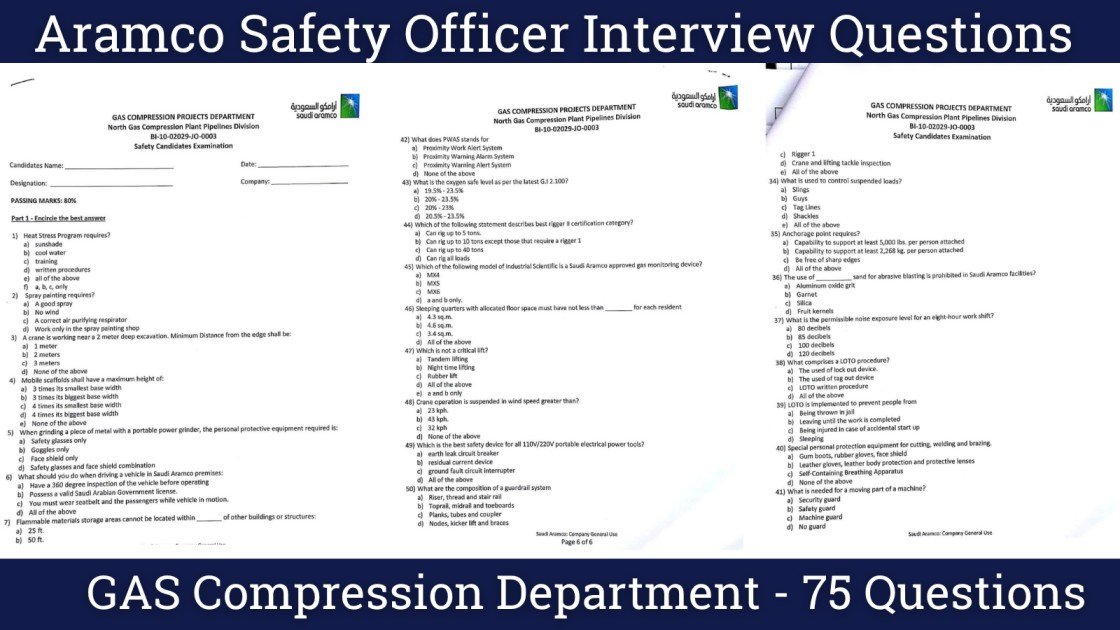
In this article, you will find real Aramco questions directly from a candidate examination conducted in an Aramco Project.
Safety Practice Questions & Answers
Based on the uploaded six-page examination.
Questions 1–50 | Simplified wording | Answer key included
1. What does a heat-stress program normally include?
a) Sunshade only
b) Cool drinking water only
c) Training only
d) Written procedures only
e) All of the above
Correct answer: e) All of the above
Why: A heat-stress program should include preventive measures such as shade, water, training, and procedures.
Reference: OSHA — Heatcite
2. What respiratory protection is required for spray painting?
a) A good spray pattern
b) No wind
c) A suitable air-purifying respirator
d) Working only inside a spray-painting shop
Correct answer: c) A suitable air-purifying respirator
Why: Spray-painting work may expose workers to hazardous vapors, gases, or particles. The appropriate respirator depends on the hazard assessment.
Reference: OSHA — Respiratory Protection
3. A crane is working near a 2-meter-deep excavation. What minimum distance should be maintained from the edge?
a) 1 meter
b) 2 meters
c) 3 meters
d) None of the above
Correct answer: ⚠️ Verify against the applicable Aramco excavation/crane procedure.
Why: The safe distance depends on the excavation stability, crane loading, soil conditions, and the applicable company requirements. The general principle is to prevent surcharge loading and collapse at the excavation edge.
Reference: OSHA — Excavations
4. A mobile scaffold should not exceed what height-to-base-width ratio?
a) 3 times its smallest base width
b) 3 times its largest base width
c) 4 times its smallest base width
d) 4 times its largest base width
e) None of the above
Correct answer: a) 3 times its smallest base width
Why: A mobile scaffold must be stable and should not exceed the applicable height-to-base-width limit.
Reference: OSHA — Scaffolds
5. What PPE is normally required when grinding metal with a portable power grinder?
a) Safety glasses only
b) Goggles only
c) Face shield only
d) Safety glasses and face shield
Correct answer: d) Safety glasses and face shield
Why: Eye protection is required against flying particles, and a face shield provides additional facial protection.
Reference: OSHA — Hand and Power Tools
6. What should a driver do before operating a vehicle on Saudi Aramco premises?
a) Inspect the vehicle
b) Have a valid driving license
c) Ensure occupants wear seat belts
d) All of the above
Correct answer: d) All of the above
Why: Vehicle inspection, authorization to drive, and seat-belt use are fundamental safety requirements.
Reference: OSHA — Motor Vehicles
7. Flammable materials should not be stored within what distance of buildings or structures?
a) 25 ft
b) 50 ft
c) 50 meters
d) 100 ft
Correct answer: b) 50 ft
Why: The uploaded question identifies 50 ft as the expected answer. However, the exact storage distance depends on the material and applicable fire-safety requirements.
Reference: OSHA — Flammable Liquids
8. What is the minimum safe distance from an overhead power line up to 50 kV?
a) 4.6 m
b) 3.1 m
c) 6.1 m
d) 7.6 m
Correct answer: c) 6.1 m
Why: OSHA’s Table A gives a minimum clearance of 10 ft for lines up to 50 kV, but the uploaded question uses the 6.1 m answer. This should be checked against the applicable Aramco electrical-safety procedure before publication.
Reference: OSHA — Cranes and Power Lines
9. How far should an extension ladder extend above a roof or platform?
a) 1 foot
b) 4 feet
c) 1 meter
d) No specific distance
Correct answer: b) 4 feet
Why: A ladder used for access should extend at least 3 feet above the landing surface.
Reference: OSHA — Ladders
10. Which General Instruction covers work-permit requirements?
a) GI 1.200
b) GI 5.430
c) GI 2.100
d) GI 6.200
Correct answer: c) GI 2.100
Why: This is an Aramco-specific reference from the uploaded examination. It should be confirmed against the latest approved company document.
Reference: Saudi Aramco — Official Website
11. Within what period should a preliminary investigation report be submitted after a job-site injury?
a) 2 hours
b) 24 hours
c) 8 hours
d) 3 days
Correct answer: ⚠️ Verify against the applicable Aramco incident-reporting procedure.
Why: Incident-reporting deadlines are company-specific. Do not publish this as a confirmed Aramco requirement without checking the current procedure.
Reference: OSHA — Recordkeeping
12. Which excavation requires an excavation plan?
a) A 1.2 m excavation considered a confined space
b) A 6.1 m excavation for a sewer pipe
c) A 2.4 m excavation with Type A soil
d) None of the above
Correct answer: ⚠️ Verify against the applicable Aramco excavation-planning procedure.
Why: Excavation-plan requirements depend on depth, soil conditions, location, hazards, and the applicable company rules.
Reference: OSHA — Excavations
13. How far should excavated spoil be kept from the edge?
a) 1 meter
b) 6 ft
c) 3 ft
d) 2 ft
Correct answer: d) 2 ft
Why: OSHA requires excavated material to be kept at least 2 feet from the excavation edge.
Reference: OSHA — Excavation Spoils
14. What is the maximum working pressure for an acetylene gauge?
a) 7 psig
b) 10 psig
c) 15 psig
d) 19.50 psig
Correct answer: c) 15 psig
Why: Acetylene should not be used above 15 psig because of its instability at higher pressures.
Reference: OSHA — Acetylene
15. Which General Instruction covers heavy-equipment operator and rigger testing and certification?
a) GI 7.026
b) GI 7.025
c) GI 6.030
d) GI 7.028
e) None of the above
Correct answer: a) GI 7.026
Why: This is an Aramco-specific reference from the uploaded examination and should be checked against the latest approved document.
Reference: Saudi Aramco — Official Website
16. Which fire class involves ordinary combustible materials?
a) Class A
b) Class B
c) Class C
d) Class D
Correct answer: a) Class A
Why: Class A fires involve materials such as wood, paper, cloth, and many plastics.
Reference: OSHA — Fire Protection
17. Which soil type is generally the least stable in an excavation?
a) Type A
b) Type B
c) Type C
d) None of the above
Correct answer: c) Type C
Why: Type C is the least stable of the three OSHA soil classifications.
Reference: OSHA — Soil Classification
18. What is required when working on a steel beam six feet or more above ground?
a) A steel belt
b) A full-body harness connected to a proper anchorage point
c) No fall protection is needed
d) None of the above
Correct answer: b) A full-body harness connected to a proper anchorage point
Why: Fall protection is required when workers are exposed to a fall hazard.
Reference: OSHA — Fall Protection
19. What minimum force should a roof-edge barricade be able to withstand?
a) 100 lb
b) 150 lb
c) 200 lb
d) 125 lb
Correct answer: c) 200 lb
Why: OSHA requires guardrail systems to withstand a 200-pound force applied in the outward or downward direction.
Reference: OSHA — Guardrails
20. Which item does not affect the load capacity of a mobile crane?
a) Boom length
b) Boom angle
c) Fully extended outriggers
d) Anti-two-block device
Correct answer: d) Anti-two-block device
Why: The anti-two-block device is a safety device that helps prevent contact between the hook block and boom tip.
Reference: OSHA — Cranes and Derricks
21. What should personnel do when an emergency alarm sounds?
a) Shout to inform others
b) Run outside immediately
c) Evacuate calmly to the designated assembly area
d) None of the above
Correct answer: c) Evacuate calmly to the designated assembly area
Why: Emergency procedures should direct workers to evacuate safely and report to the designated assembly area.
Reference: OSHA — Emergency Action Plans
22. Which ANSI standard applies to industrial hard hats?
a) Z87.1
b) Z359.1
c) Z89.1
d) None of the above
Correct answer: c) Z89.1
Why: ANSI Z89.1 covers industrial head protection.
Reference: ANSI — Z89.1
23. What is the normal validity of a work permit?
a) 1 month
b) 1 week
c) 1 shift
d) 1 day
Correct answer: c) 1 shift
Why: The uploaded examination identifies one shift as the expected answer. Permit validity is company-specific and should be confirmed against the latest approved procedure.
Reference: OSHA — Permit-Required Confined Spaces
24. What is the maximum distance between access ladders in an excavation?
a) 10 ft
b) 75 ft
c) 50 ft
d) 25 ft
Correct answer: c) 50 ft
Why: OSHA requires ladders or other safe access points so that workers do not have to travel more than 25 feet laterally. The uploaded question’s 50 ft answer should be checked against the applicable Aramco requirement.
Reference: OSHA — Excavation Access
25. What are the three characteristics of a confined space?
a) Not intended for continuous human occupancy
b) Limited access and egress
c) Large enough for a worker to enter and perform work
d) All of the above
Correct answer: d) All of the above
Why: These are the standard characteristics used to identify a confined space.
Reference: OSHA — Confined Spaces
26. A crane contacts an overhead power line. What should the operator do?
a) Jump out and run away
b) Stay in the crane until emergency crews arrive
c) Ask the oiler to remove the line
d) Swing the boom until the line falls off
Correct answer: b) Stay in the crane until emergency crews arrive
Why: The operator should remain in the cab unless there is an immediate fire or other emergency requiring evacuation.
Reference: OSHA — Cranes and Power Lines
27. Which material is not classified as a Class B fire?
a) Diesel, petroleum, methane
b) Liquefied petroleum gas
c) Cooking oil, olive oil, coconut oil
d) Propane, butane
Correct answer: c) Cooking oil, olive oil, coconut oil
Why: Cooking oils are classified as Class K fires under OSHA’s fire-classification system.
Reference: OSHA — Fire Protection
28. Compressed-gas cylinders should not be stored where the temperature can exceed:
a) 45°C
b) 53°C
c) 54°C
d) 34°F
Correct answer: c) 54°C
Why: The uploaded examination identifies 54°C as the expected answer. The exact storage temperature limit should be verified against the applicable cylinder-storage requirements.
Reference: OSHA — Compressed Gas Cylinders
29. How long should a fire watch remain after hot work stops?
a) 10 minutes
b) 15 minutes
c) 30 minutes
d) 60 minutes
Correct answer: c) 30 minutes
Why: The uploaded examination identifies 30 minutes as the expected answer. Actual fire-watch duration may depend on the hot-work procedure and site conditions.
Reference: OSHA — Welding, Cutting, and Brazing
30. What is the purpose of an anti-two-block device on a crane?
a) To determine the load weight
b) To prevent cribbing blocks from touching outriggers
c) To measure the extended wire-rope length
d) To prevent the hook block from contacting the boom tip
Correct answer: d) To prevent the hook block from contacting the boom tip
Why: The anti-two-block device helps prevent dangerous contact between the hook block and the boom tip.
Reference: OSHA — Cranes and Derricks
31. What does MSDS stand for?
a) Material Safety Day Shift
b) Material Specification Data Sheet
c) Material Safety Data Sheet
d) None of the above
Correct answer: c) Material Safety Data Sheet
Why: MSDS is the older term for a Safety Data Sheet (SDS), which provides information about chemical hazards and safe handling.
Reference: OSHA — Hazard Communication
32. Which gas is colorless, flammable, and toxic?
a) Carbon monoxide
b) Hydrogen dioxide
c) Methane
d) Hydrogen sulfide
Correct answer: d) Hydrogen sulfide
Why: Hydrogen sulfide is a colorless, flammable, and highly toxic gas.
Reference: OSHA — Hydrogen Sulfide
33. What is required when lifting 3 meters around or adjacent to process piping?
a) Critical lifting plan
b) Hot-work permit
c) Rigger 1
d) Crane and lifting-tackle inspection
e) All of the above
Correct answer: ⚠️ Verify against the applicable Aramco lifting procedure.
Why: The uploaded question is incomplete because the beginning of the question appears on the previous page. The exact answer should be confirmed from the complete original question and current company procedure.
Reference: OSHA — Cranes and Derricks
34. What is used to control a suspended load?
a) Slings
b) Guys
c) Tag lines
d) Shackles
e) All of the above
Correct answer: c) Tag lines
Why: Tag lines are used to help control and guide suspended loads.
Reference: OSHA — Rigging Equipment
35. What is required for an anchorage point?
a) Support at least 5,000 lb per person
b) Support at least 2,268 kg per person
c) Be free of sharp edges
d) All of the above
Correct answer: d) All of the above
Why: OSHA requires personal fall-arrest anchorage points to support at least 5,000 lb per attached worker and meet other applicable requirements.
Reference: OSHA — Personal Fall Arrest Systems
36. Which abrasive material is prohibited for blasting?
a) Aluminum oxide grit
b) Garnet
c) Silica
d) Fruit kernels
Correct answer: c) Silica
Why: Silica blasting can create respirable crystalline silica, which can cause serious lung disease.
Reference: OSHA — Silica
37. What is the permissible noise exposure level for an eight-hour shift?
a) 80 dB
b) 85 dB
c) 100 dB
d) 120 dB
Correct answer: b) 85 dB
Why: OSHA’s action level for occupational noise exposure is 85 dBA for an eight-hour time-weighted average.
Reference: OSHA — Occupational Noise Exposure
38. What does a LOTO procedure include?
a) Lockout device
b) Tagout device
c) Written LOTO procedure
d) All of the above
Correct answer: d) All of the above
Why: Lockout/tagout includes the use of locks, tags, and written procedures to control hazardous energy.
Reference: OSHA — Lockout/Tagout
39. Why is LOTO implemented?
a) To prevent people from being jailed
b) To stop workers leaving before work is complete
c) To prevent injury from accidental start-up or release of energy
d) To prevent sleeping
Correct answer: c) To prevent injury from accidental start-up or release of energy
Why: LOTO protects workers from hazardous energy during maintenance or servicing.
Reference: OSHA — Lockout/Tagout
40. What PPE is required for cutting, welding, and brazing?
a) Gumboots, rubber gloves, and face shield
b) Leather gloves, leather body protection, and protective lenses
c) Self-contained breathing apparatus
d) None of the above
Correct answer: b) Leather gloves, leather body protection, and protective lenses
Why: Welding and cutting require appropriate eye, face, hand, and body protection against sparks, heat, and radiation.
Reference: OSHA — Welding, Cutting, and Brazing
41. What is required to protect workers from moving machine parts?
a) Security guard
b) Safety guard
c) Machine guard
d) No guard
Correct answer: c) Machine guard
Why: Machine guards prevent contact with dangerous moving parts.
Reference: OSHA — Machine Guarding
42. What does PWAS stand for?
a) Proximity Work Alert System
b) Proximity Warning Alarm System
c) Proximity Warning Alert System
d) None of the above
Correct answer: ⚠️ Verify against the applicable Aramco procedure.
Why: PWAS is an Aramco-specific abbreviation in the uploaded question. It should be checked against the latest approved document before publication.
Reference: Saudi Aramco — Official Website
43. What is the normal oxygen concentration range for safe breathing air?
a) 19.5%–23.5%
b) 20%–23.5%
c) 20%–23%
d) 20.5%–23.5%
Correct answer: a) 19.5%–23.5%
Why: OSHA defines oxygen-deficient air as below 19.5% and oxygen-enriched air as above 23.5%.
Reference: OSHA — Confined Spaces
44. What best describes a Rigger II?
a) Can rig loads up to 5 tons
b) Can rig loads up to 10 tons except those requiring a Rigger I
c) Can rig loads up to 40 tons
d) Can rig all loads
Correct answer: b) Can rig loads up to 10 tons except those requiring a Rigger I
Why: This is an Aramco-specific certification category and should be confirmed against the latest approved lifting and rigging requirements.
Reference: Saudi Aramco — Official Website
45. Which Industrial Scientific gas-monitoring models are identified as approved in the uploaded question?
a) MX4
b) MX5
c) MX6
d) a and b only
Correct answer: ⚠️ Verify against the latest approved Aramco equipment list.
Why: Equipment approval is company-specific and may change. Do not publish this as a confirmed current Aramco answer without checking the latest approved list.
Reference: Industrial Scientific — Gas Detection
46. What minimum floor space should be provided per resident in sleeping quarters?
a) 4.3 sq. m
b) 4.6 sq. m
c) 3.4 sq. m
d) All of the above
Correct answer: ⚠️ Verify against the applicable Aramco accommodation standard.
Why: Accommodation requirements are company-specific and should be checked against the current approved standard.
Reference: Saudi Aramco — Official Website
47. Which is not normally classified as a critical lift?
a) Tandem lifting
b) Night-time lifting
c) Rubber lift
d) All of the above
e) a and b only
Correct answer: c) Rubber lift
Why: Tandem lifting and night lifting may require special planning. “Rubber lift” is not a standard critical-lift category in the uploaded options.
Reference: OSHA — Cranes and Derricks
48. At what wind speed should crane operations be suspended?
a) 23 kph
b) 43 kph
c) 32 kph
d) None of the above
Correct answer: ⚠️ Verify against the crane manufacturer’s limits and applicable Aramco lifting procedure.
Why: Crane wind limits depend on the crane, load, boom configuration, and manufacturer’s instructions.
Reference: OSHA — Cranes and Derricks
49. What is the best protection for portable 110/220V electrical power tools?
a) Earth-leak circuit breaker
b) Residual current device
c) Ground-fault circuit interrupter
d) All of the above
Correct answer: c) Ground-fault circuit interrupter
Why: A GFCI helps protect workers from electric shock by interrupting the circuit when it detects an imbalance in current.
Reference: OSHA — Electrical Safety
50. What are the main components of a guardrail system?
a) Riser, thread, and stair rail
b) Toprail, midrail, and toeboards
c) Planks, tubes, and couplers
d) Nodes, kicker lift, and braces
Correct answer: b) Toprail, midrail, and toeboards
Why: Guardrail systems use toprails and midrails, with toeboards where required to help prevent falls and falling objects.
Reference: OSHA — Guardrails
Safety officer
Yes, but what safety officer? Do you want more questions?
Yes Ma’am
How to take the Aramco Approval process
I had already shared it on my website… just search on Google “how to take Aramco approval by alsaifjobs.com”
You will get the first post from alsaifjobs.com.
Kindly read the entire blog post; you’ll get approval for sure